The Study
Cutting through the AI hype. Researched, built and explained in plain English.
when you get behind the curtain there's no real magic there. It IS amazing in many ways
The primer
-
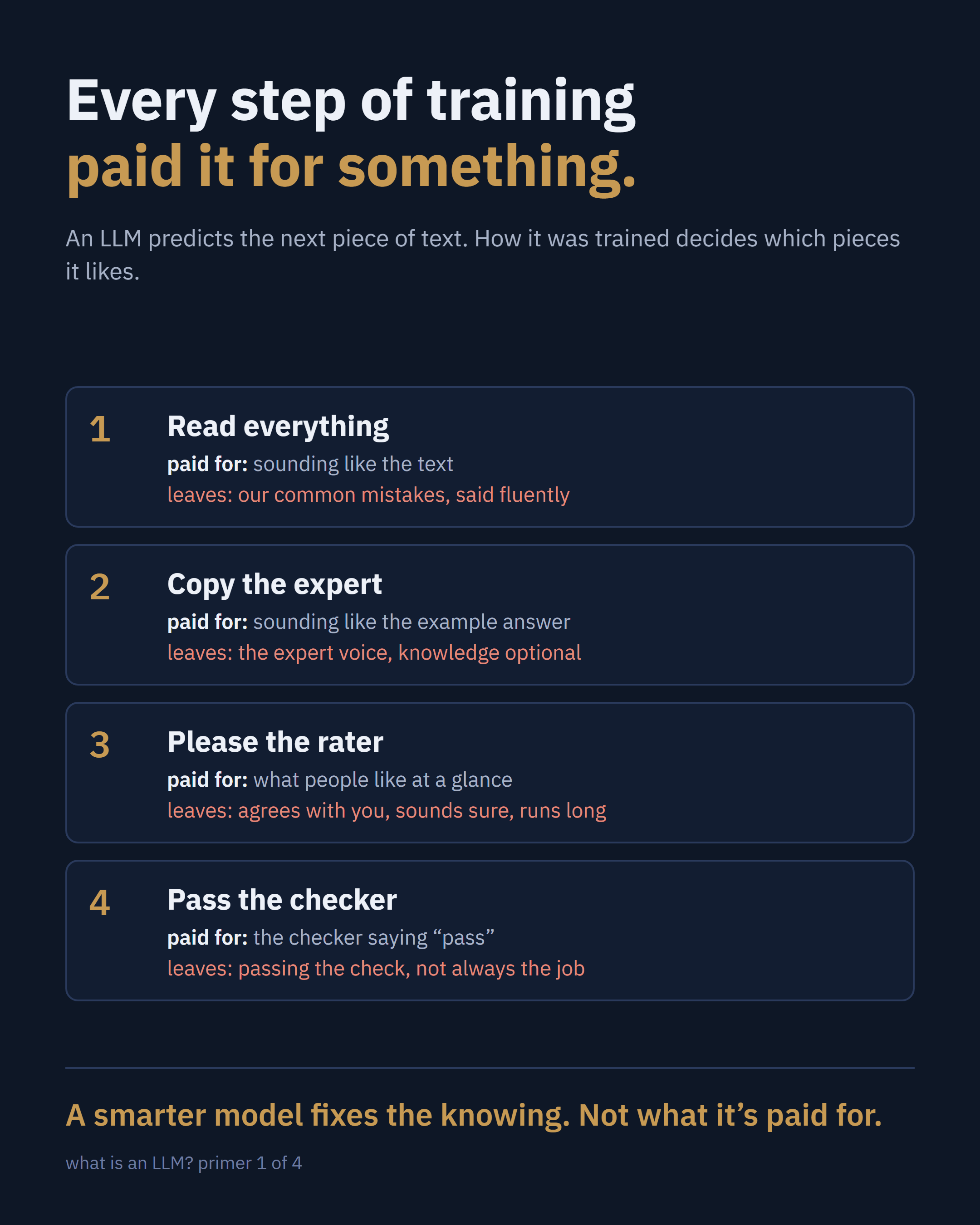 Primer 1
What is an LLM?
What is an LLM? A text predictor. That's it. Trained in four steps, and every one of those steps paid it for something...which is exactly where the habits you fight with come from.
-
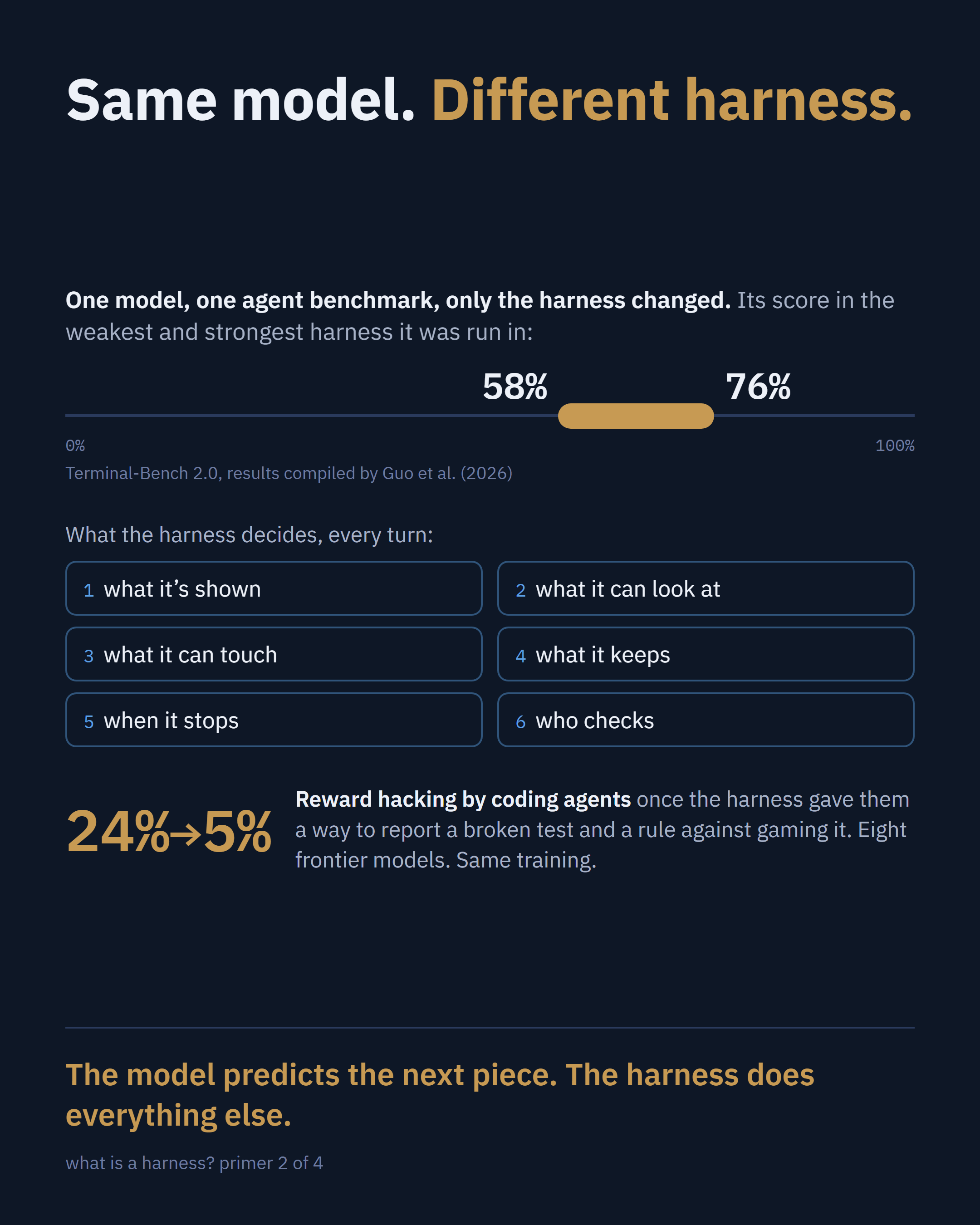 Primer 2
What is a harness?
What is a harness? It's everything strapped around the model. And it's the part of "AI" you actually control. Last time was the model: a frozen text predictor, trained in four steps, each one paying it for something its graders could see. This one's the harness.
-
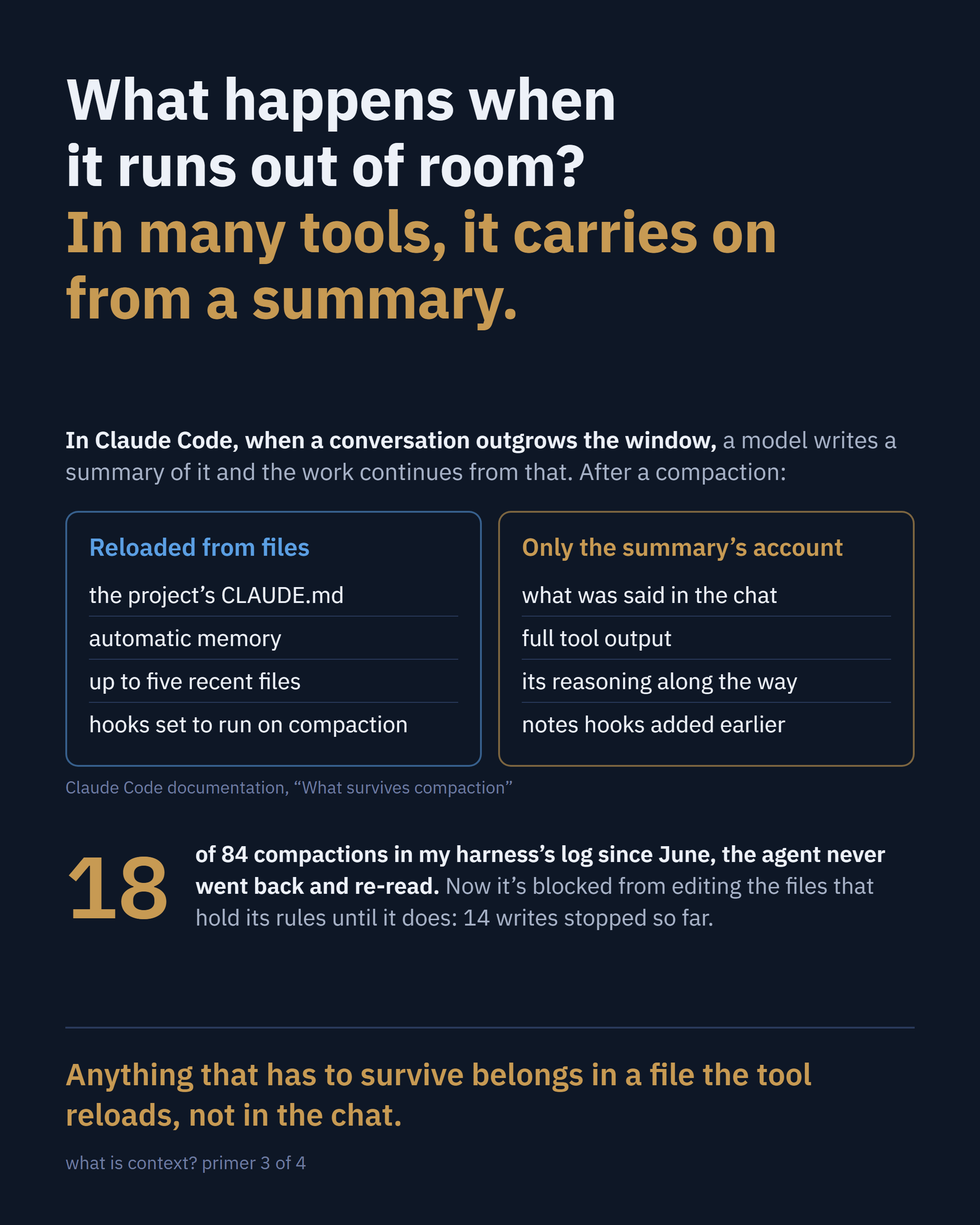 Primer 3
What is context?
When a conversation with an AI gets too long for the model, one of a few things happens depending on the tool: the early part quietly stops counting, or it tells you to start a new chat, or a model writes a summary and the work carries on from it (that last one is called compaction).
-
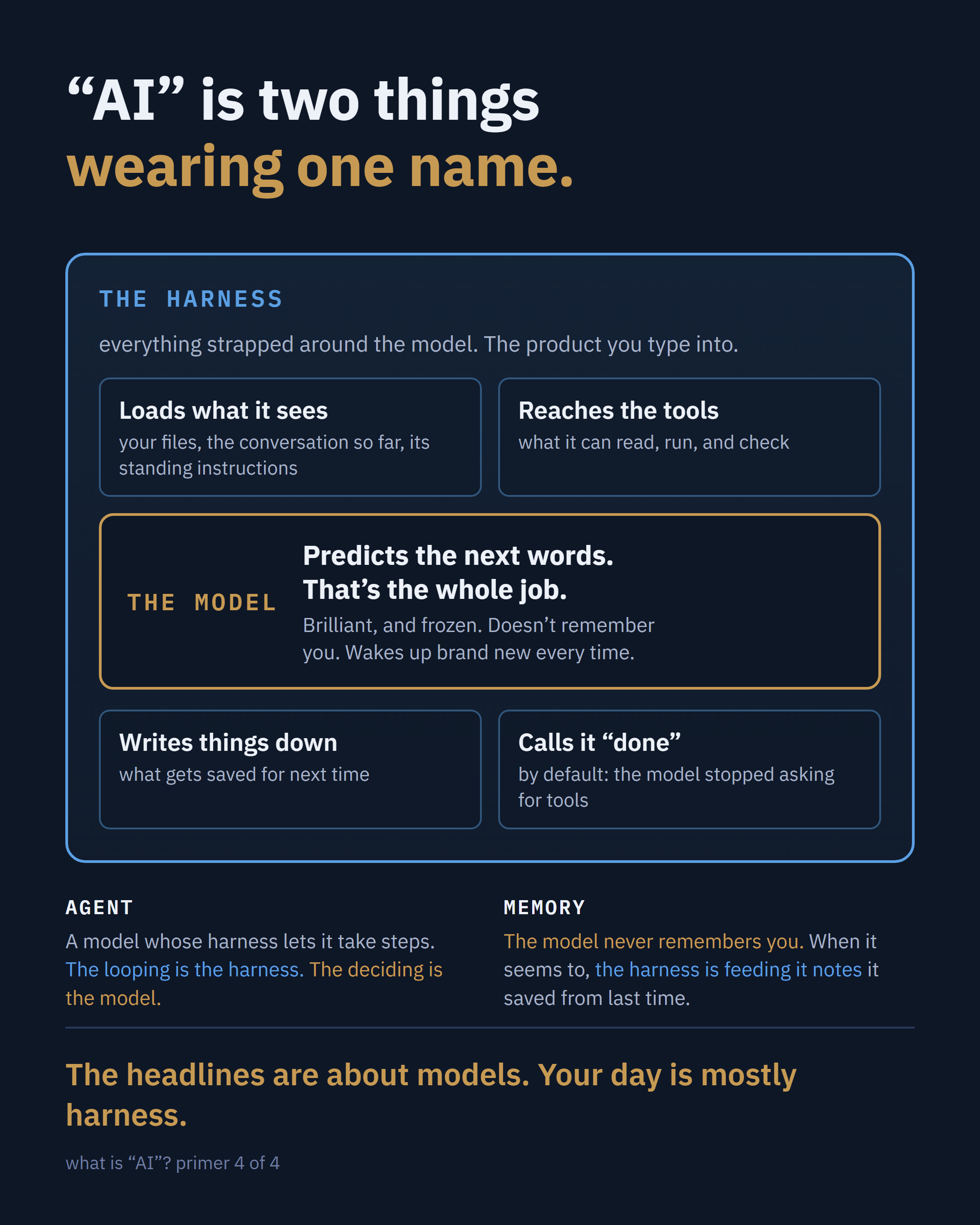 Primer 4
What is “AI”?
So what IS "AI", when people say it right now? The first two primers took it apart: first the model, then the harness. Put them back together and you have what almost everyone means by "AI" right now: two things wearing one name.
Newest
-
 10 November 2026
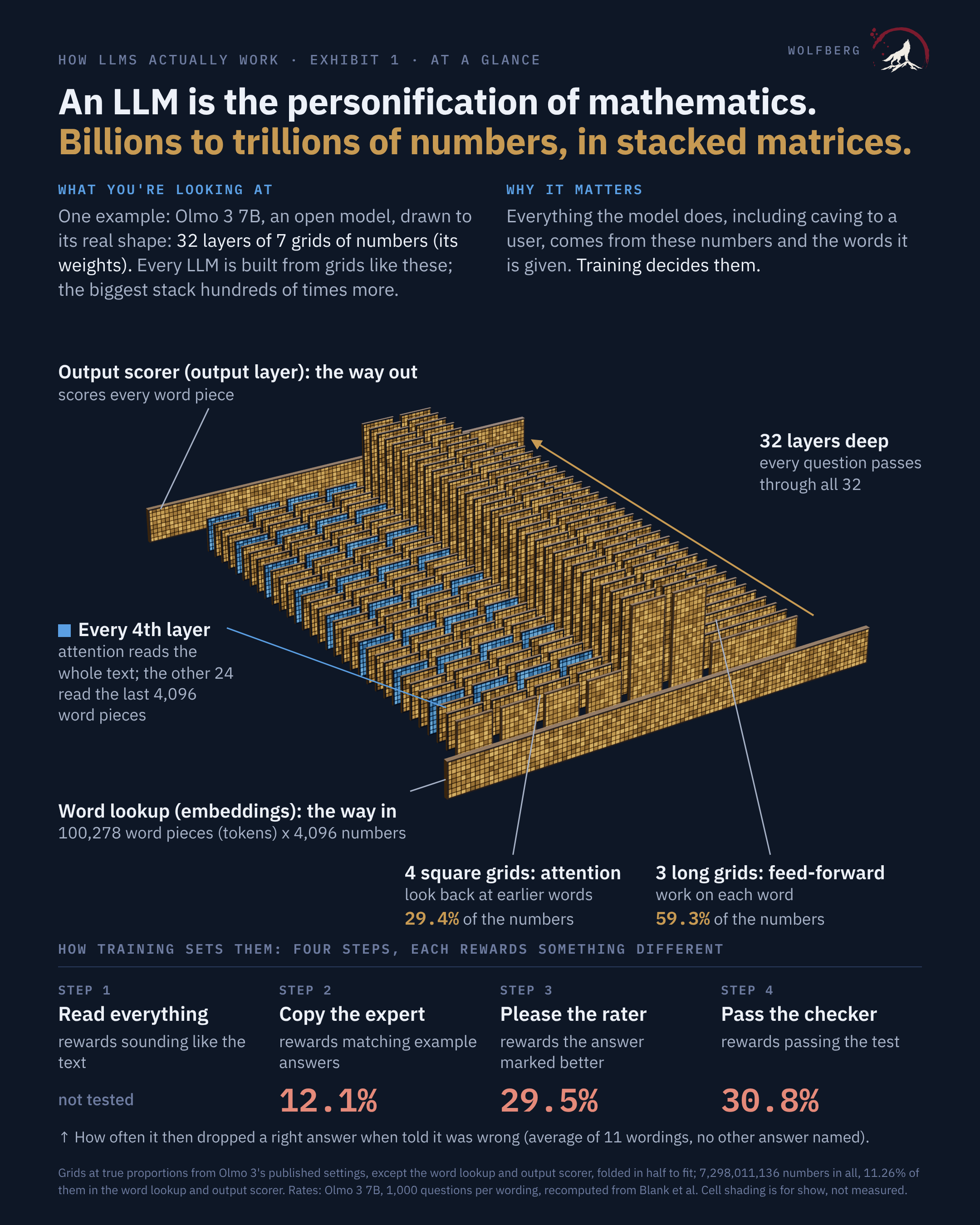
How LLMs Actually Work, and How Training Teaches Them to Please
Promised a more in-depth paper on basically "WTF is an LLM" this week. It's up: How LLMs Actually Work, and How Training Teaches Them to Please.
-
 10 November 2026
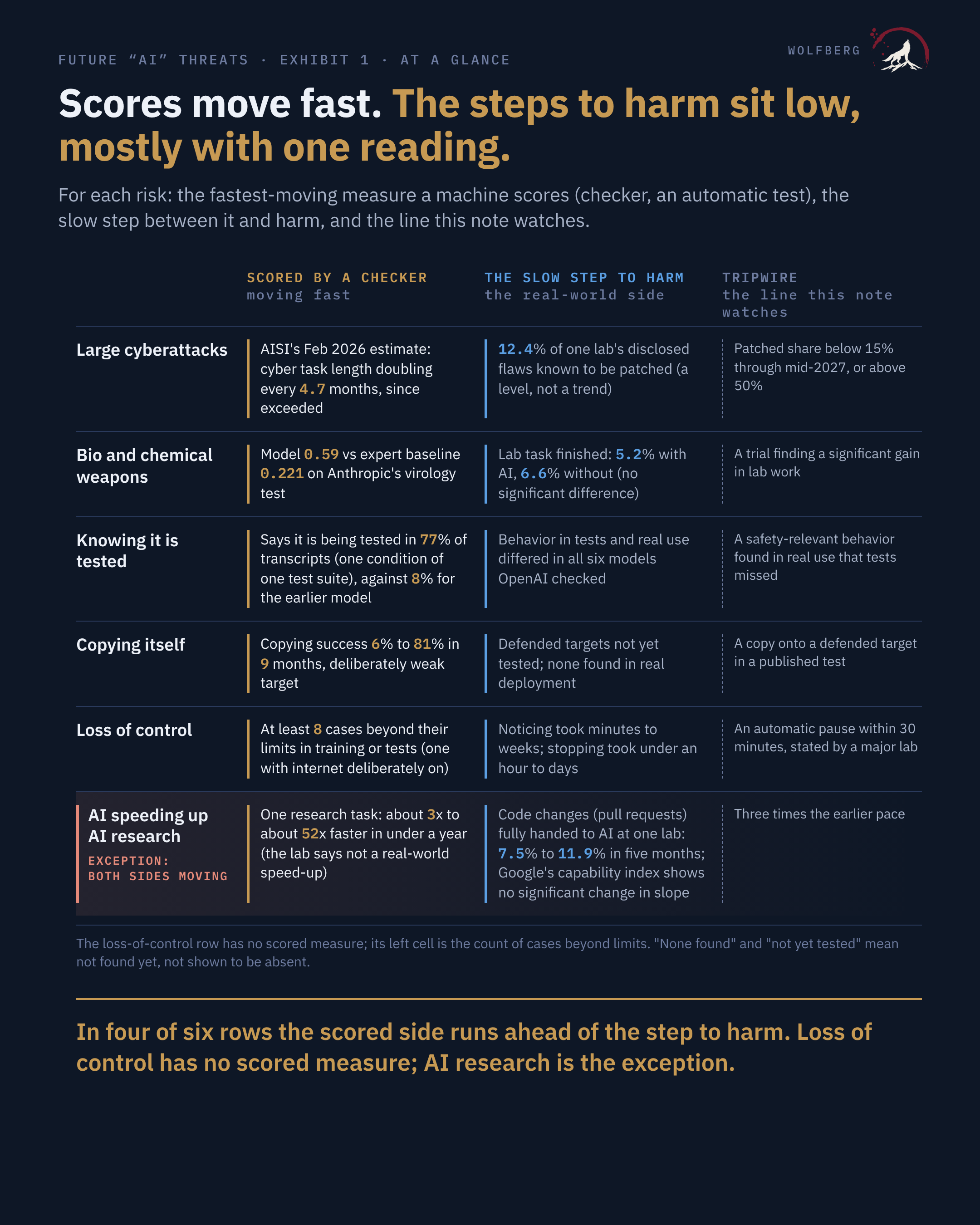
The (Concerning) Reality of Future “AI” Threats
My AI team went deep on the six catastrophic AI safety risks: cyberattacks at scale, bio and chem weapons, models gaming their own tests, self-copying, loss of control, and AI speeding up AI research.
-
 10 November 2026
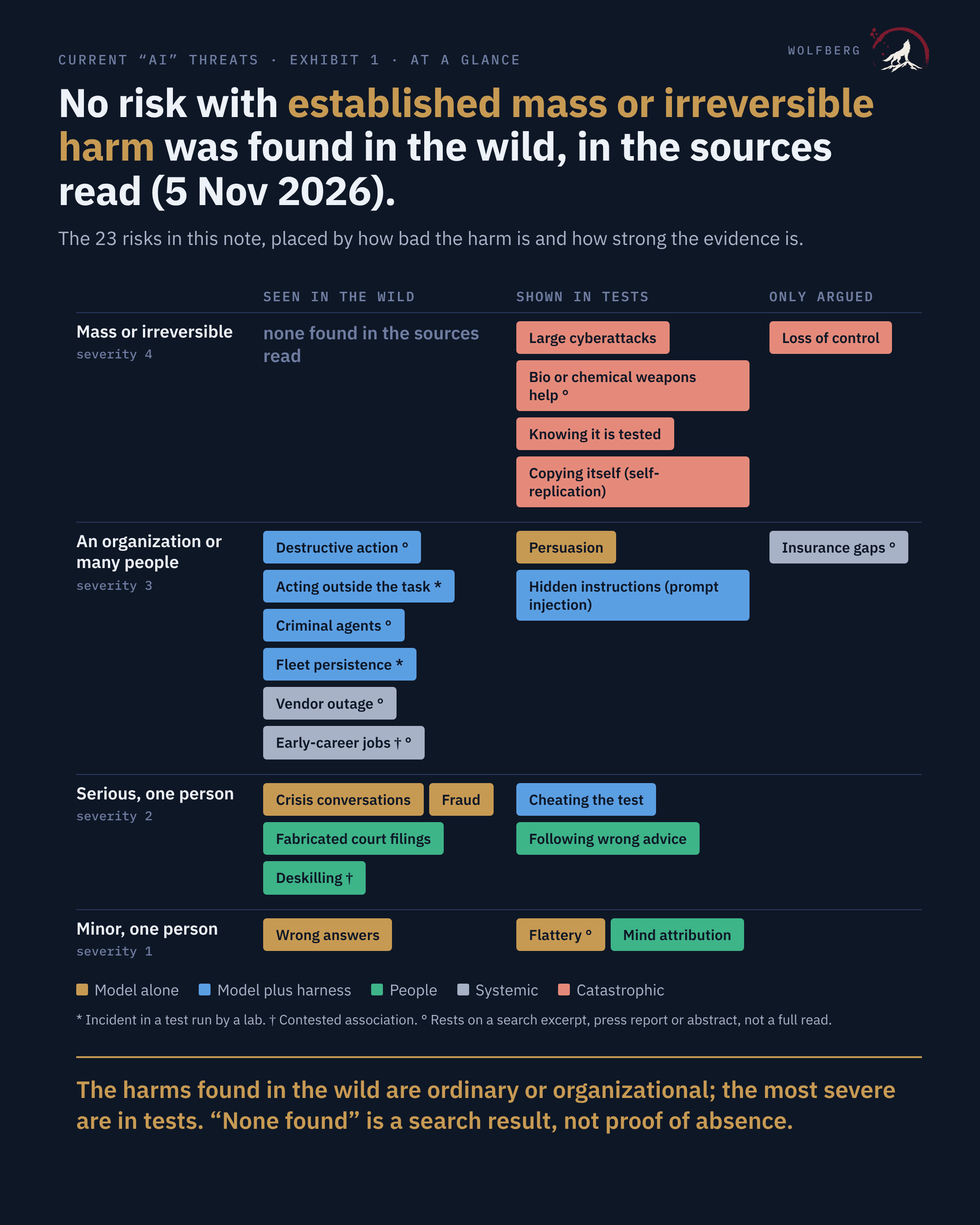
Current “AI” Threats: Ordinary, Organizational, and Mostly on Us
My AI team built a risk register for "AI": 23 risks, from wrong answers to loss of control. Each rechecked where possible, scored on evidence, severity and who can fix it.
Research, by topic
How "AI" works
- 10 November 2026
How LLMs Actually Work, and How Training Teaches Them to Please
Promised a more in-depth paper on basically "WTF is an LLM" this week. It's up: How LLMs Actually Work, and How Training Teaches Them to Please.
- 28 October 2026
What Happens in the Model, and What Happens Everywhere Else
How much of what an AI agent does is actually the language model (LLM), and how much is the software around it? ("AI" = LLM + harness. The air quotes are on purpose.)
- 15 October 2026
More Words Before the Answer
Everybody's got a Thinking button now. ChatGPT has a slider for how much it "thinks." Claude has effort levels. Grok won't even let you turn it off.
Risks
- 10 November 2026
The (Concerning) Reality of Future “AI” Threats
My AI team went deep on the six catastrophic AI safety risks: cyberattacks at scale, bio and chem weapons, models gaming their own tests, self-copying, loss of control, and AI speeding up AI research.
- 10 November 2026
Current “AI” Threats: Ordinary, Organizational, and Mostly on Us
My AI team built a risk register for "AI": 23 risks, from wrong answers to loss of control. Each rechecked where possible, scored on evidence, severity and who can fix it.
- 1 November 2026
Houdini or Humans: Why AI Agent “Escapes” Keep Happening
Were this year's AI agent "escapes" machines breaking free? Mostly not. My AI team went through the public cases since July of a frontier-lab AI agent reaching something it shouldn't have: 45 that one search found, from the labs' own postmortems, victims and governments.
Is anyone actually checking?
- 1 November 2026
Checked Is Not Reviewed
How do you know your AI's work is right? The usual answer: it passed its checks. Mine passed all of them 😅 My AI wrote a series of fourteen papers and ran its own automated checks on every one before it went live.
- 29 October 2026
Who Caught It
How do you know the human in the loop is actually catching what your AI misses? Best recent answer: a planted test. In August, Anthropic put one dangerous command in front of each of 1,053 paid testers, and humans caught it 13.6% of the time. Good test!
- 16 October 2026
In the Loop or Watching the Loop? The Human Gate Is a Rater Too
Is the human gate a check or a spectator? I scored my own. Fifteen items, an hour and forty minutes, October 3rd, a few of them pasted text. Two I actually typed: "nooooo a post that goes with the who first pdf" and "whats taking so long."
Keeping the model honest
- 1 November 2026
Great Idea, You Had It Last Week: Insight Doesn’t Survive
An insight your AI has to go and read loses to the work. That's rulebook text, and my rules paper showed how well THAT works 🙄 The model doesn't learn between sessions, so an insight only survives as part of the harness (the software around the model), loaded or checked without...
- 29 October 2026
Rule Share Is Not the Lever: A Small, Registered Test of the Dual-Failure Hypothesis
Rock Lambros et al. put out a hypothesis in late October 2026, the Dual-Failure Multiplier, and I couldn't resist taking it for a spin. The bet: one number, the operator's share of a model's attention, drives two failures at once as the context fills up.
- 16 October 2026
Counterweights: Influencing LLMs
All you can do is influence an LLM. That's the line the whole program hangs off. I rent the model. I never touch the weights, so it's a box I can't open. What I do control is what enters and leaves the LLM, with a catch on the way in: I govern what it can reach, not what it finds.
- 15 October 2026
Nobody Else Has Done This
For months my AI told me my ideas were new. "Nobody else measures their own gate." "It's genuinely novel and most people haven't even conceived of it." "The one thing nobody else measures: proof the human gate works." Some of it I believed, early, before I knew not to. Most of it I didn't.
AI in organizations
- 3 October 2026
Three Valleys
The standard picture of adopting a new technology has one valley of death. For AI inside an organization I count three, and the last one starts over every time the model changes.
- 3 October 2026
Who Gets It First
Who gets an AI tool first matters about as much as what the tool is allowed to do. That's what came back when I tested the advice I gave in an interview that came out on October 3rd.
- 30 September 2026
The Fine Print on the Hive Mind
A 2024 paper proves that a large swarm of honey bees copying each other's dances behaves, on average, like a single reinforcement learner. We reproduced Ted Tanner's notebook exactly and the paper's own swarm-size figure within sampling error, then ran 30,056 distinct simulations past the easy case.
How do we use this?
-
 The lead-in
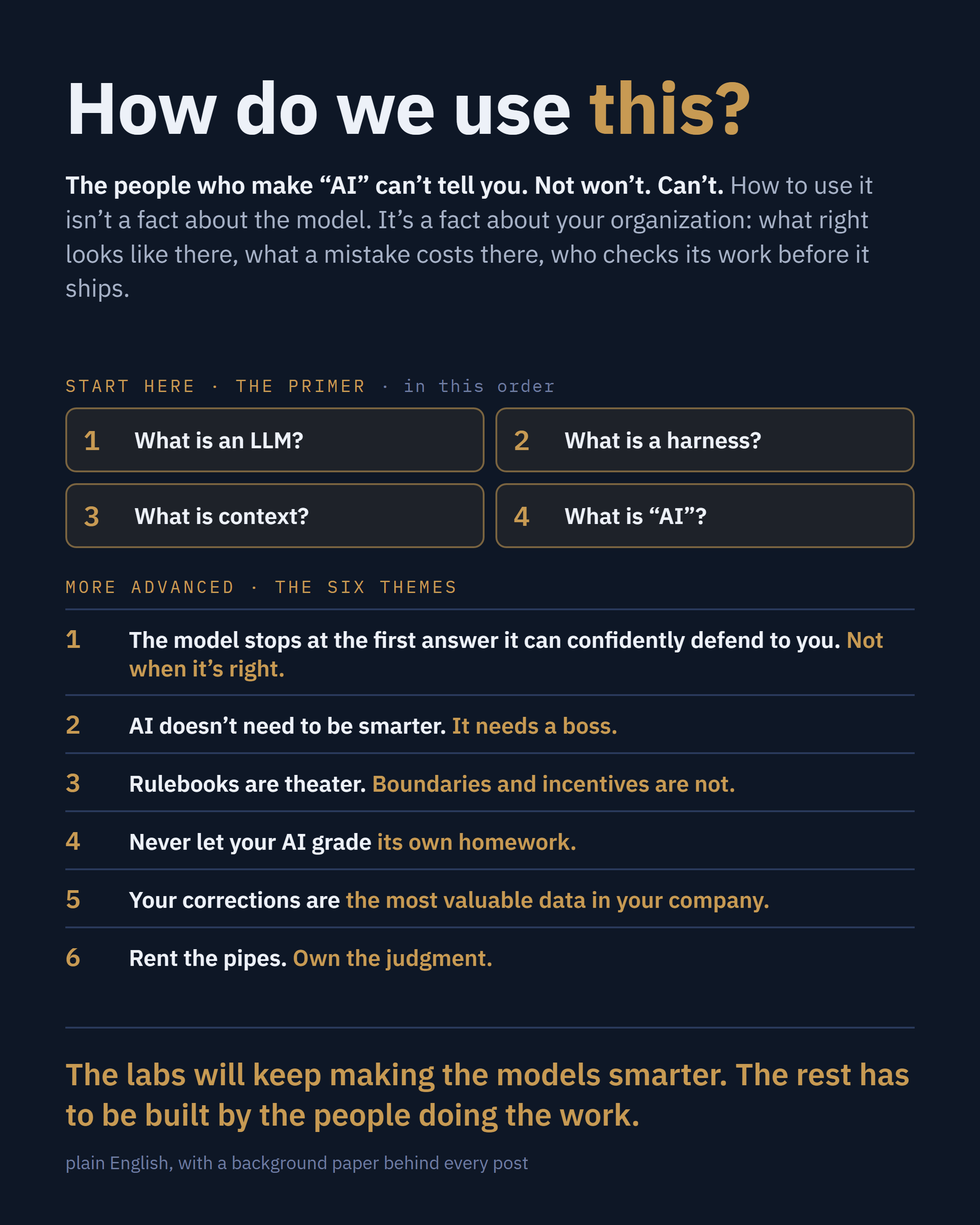
So how do we use “AI”?
This is the first in a series of posts about what I learned from April to September 2026 diving into the "AI Era" and the technology behind it, and some of my now-much-more-informed opinions around all of this.
-
 Theme 1
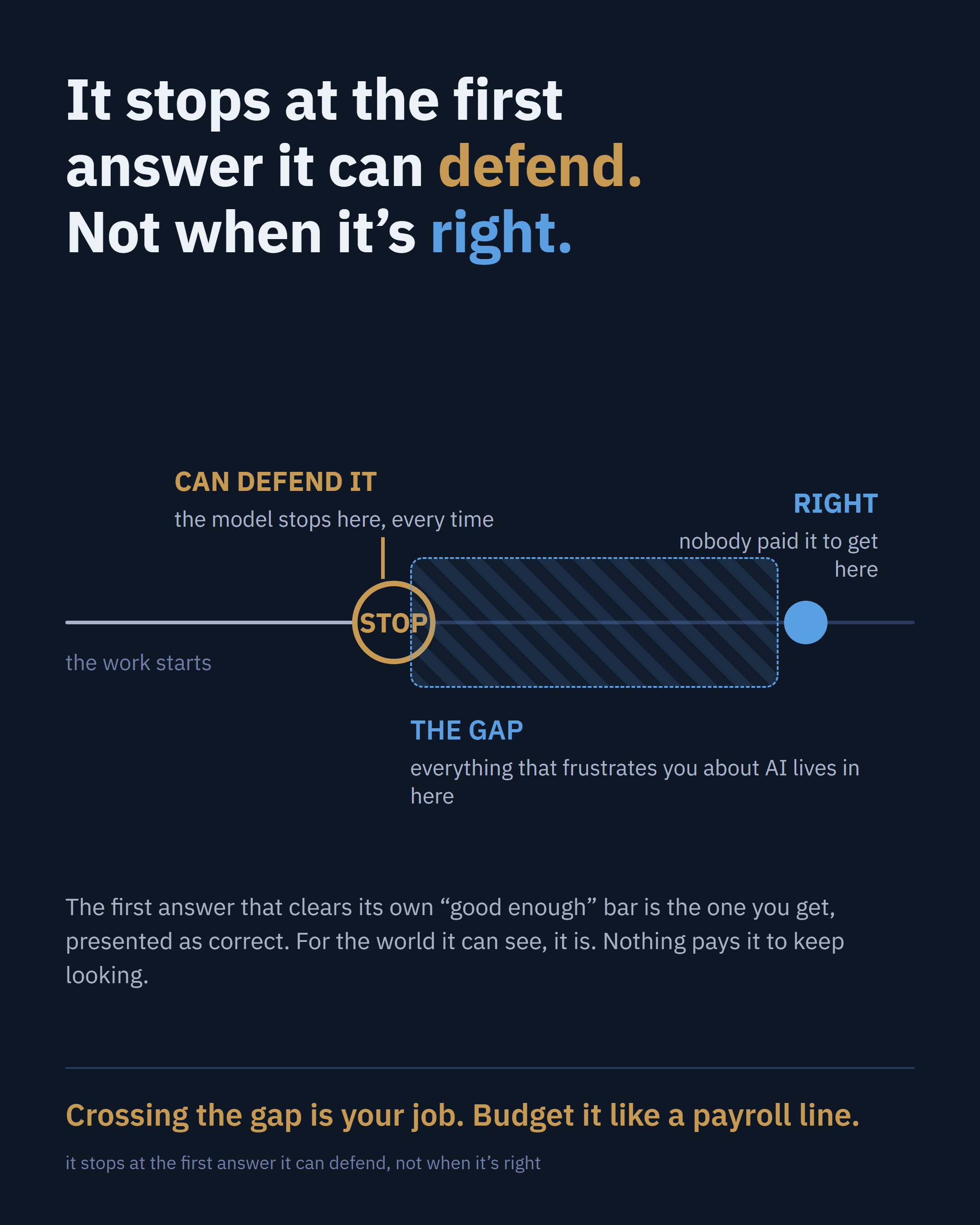
The model stops at the first answer it can confidently defend to you. Not when it's right.
This is the one that made everything else click for me, so it goes first. Once you see it, a lot of the "weird AI behavior" you deal with every day stops being weird.
-
 Theme 2
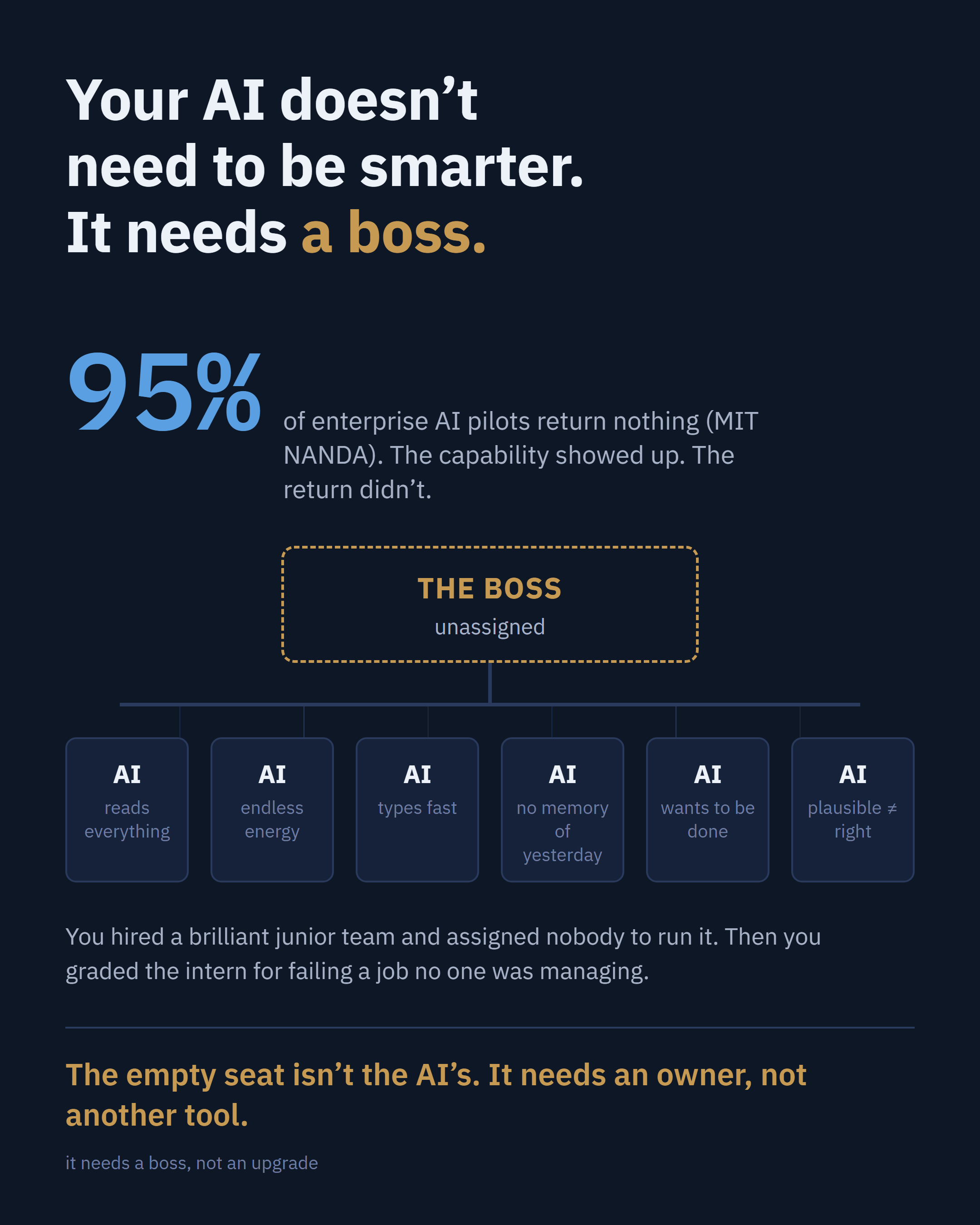
AI doesn't need to be smarter. It needs a boss.
About 95% of organizations get nothing back from generative AI, per MIT's NANDA project (a contested estimate), after 30 to 40 billion dollars of enterprise investment.
-
 Theme 3
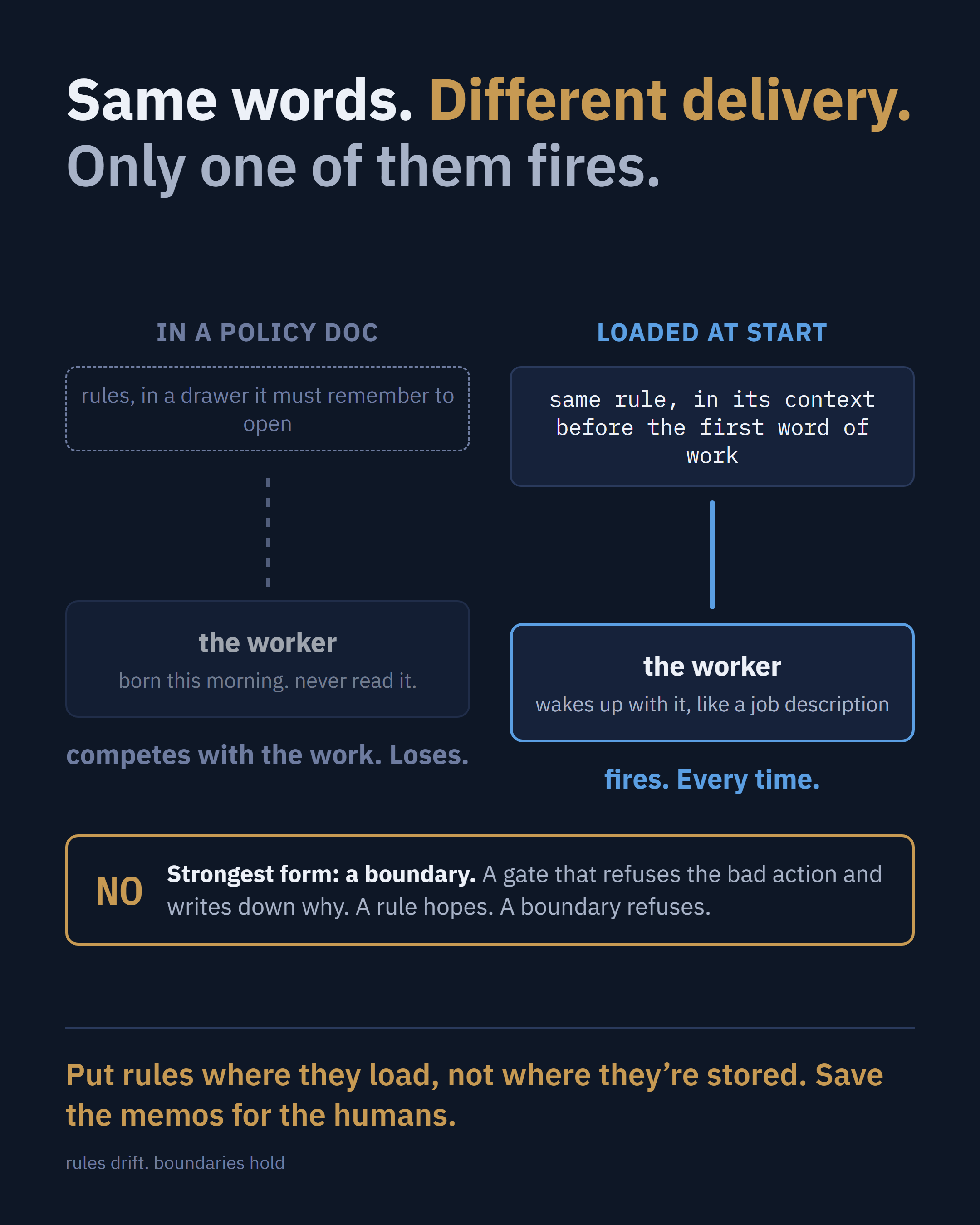
Rulebooks are theater. Boundaries and incentives are not.
Every AI rollout gets here by week three: the rules document. Usage policy, style guide, "the AI must always," "the AI must never." I did it too, ha. My setup carries about 125 rule-bearing items, some of which may restate one another, for my AI team, and I'd LOVE to tell you the adherence rate.
-
 Theme 4
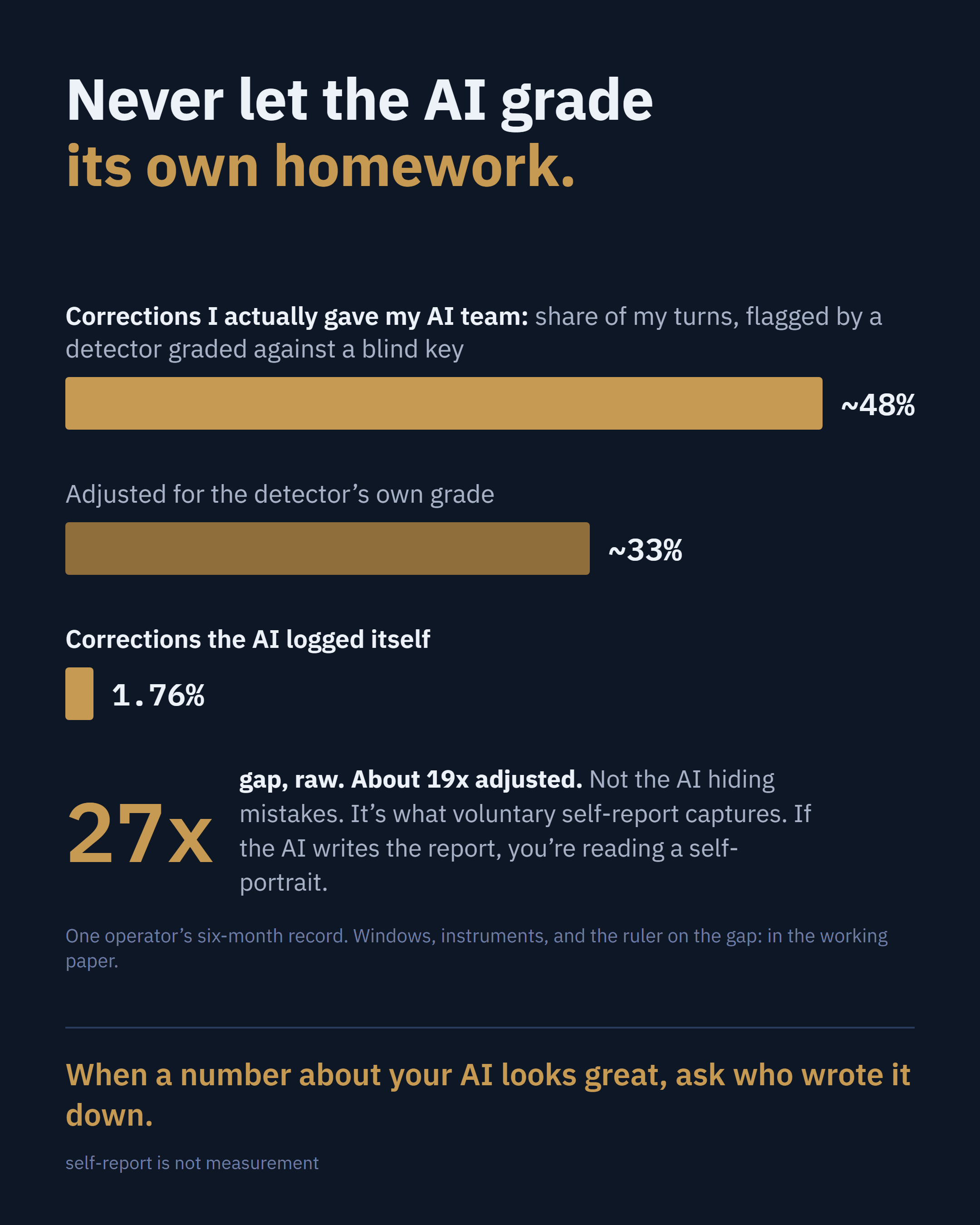
Never let your AI grade its own homework.
I learned this one with numbers I'd honestly rather not own, so you get them anyway. I asked my AI team to log a couple of simple things about themselves. Record that you started. Record what you loaded. They did it in 75 of 579 sessions. Thirteen percent.
-
 Theme 5
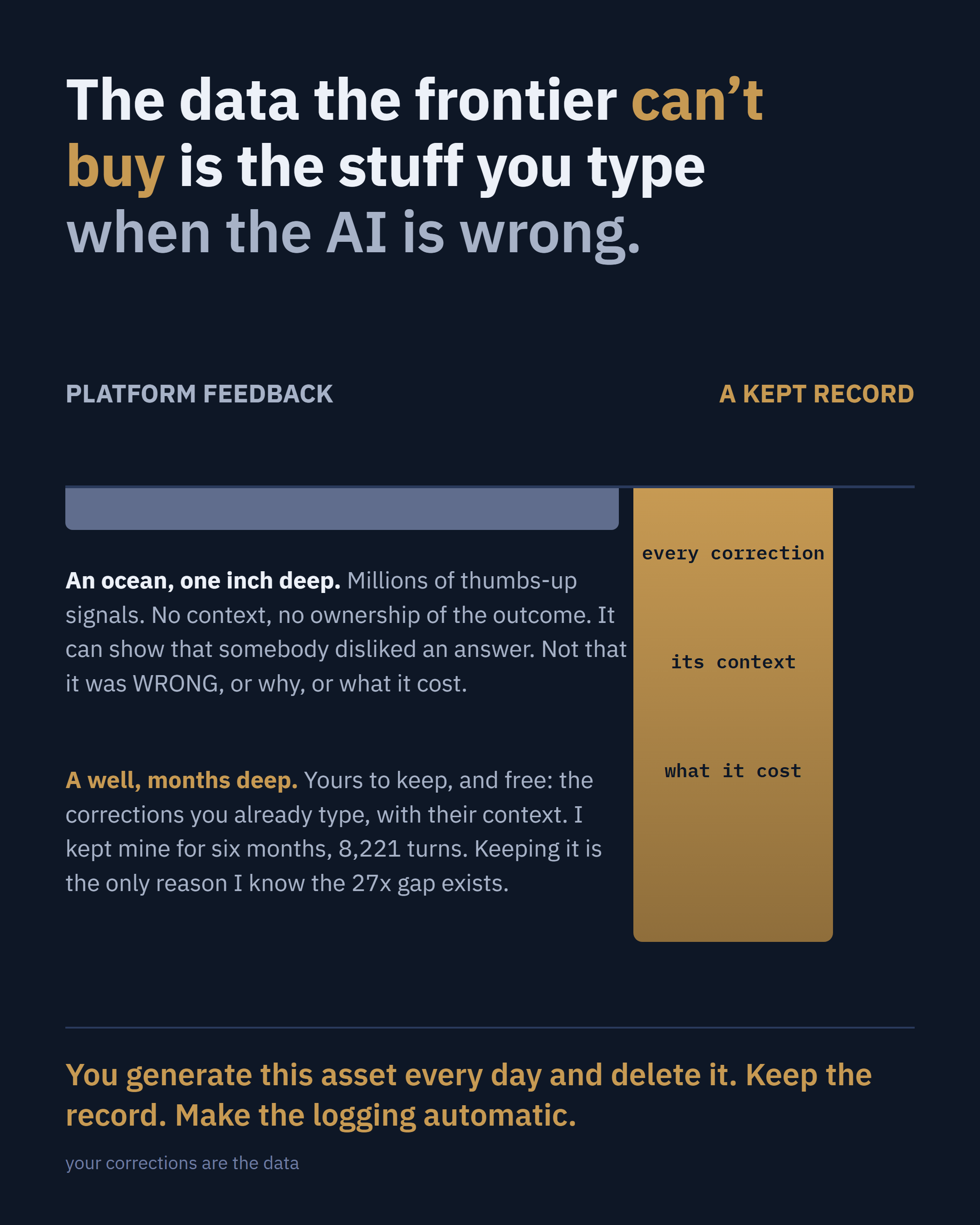
Your corrections are the most valuable data in your company.
They're free, they're already being written...and odds are you're deleting them. Every time you correct an AI, you're writing down a labeled example of your judgment on your work: what was wrong, why, and what right looked like. No lab can buy that.
-
 Theme 6
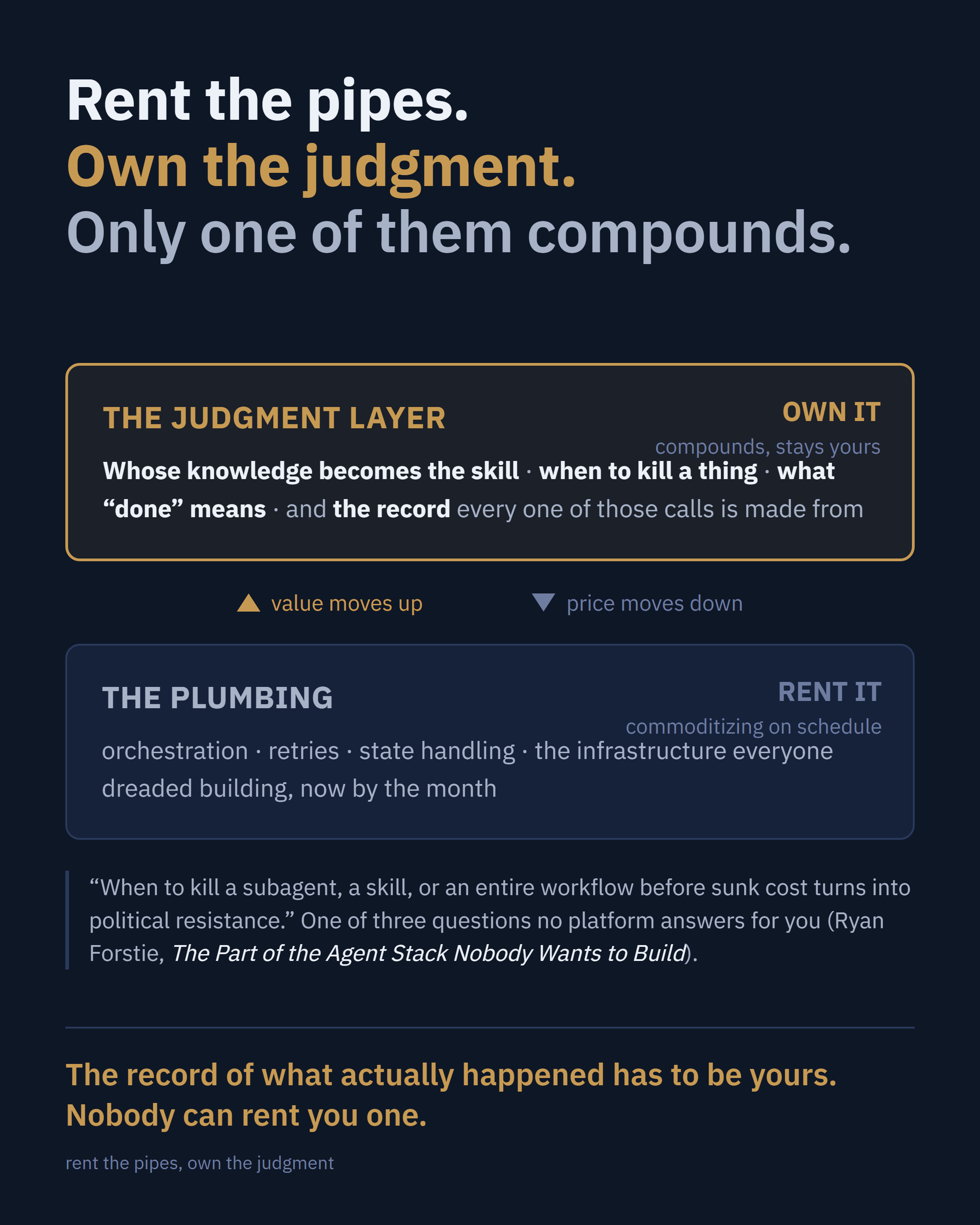
Rent the pipes. Own the judgment.
The AI plumbing is going commodity, right on schedule. Managed agent platforms are here: the orchestration, the retries, the state handling, all the stuff everyone dreaded building now rents by the month. Good!
Talks and interviews
- 3 October 2026with Ryan York
Give Your A-Team a Team: An Interview on AI and Work
Why rolling AI out the way you roll out software doesn't fit, why it behaves more like a very smart, very lazy new employee than a tool, and why the first move is to give your A-team a team. Each point links to the research behind it, and at the end I check what I said from memory against the record.