More Words Before the Answer
Everybody's got a Thinking button now. ChatGPT has a slider for how much it "thinks." Claude has effort levels. Grok won't even let you turn it off.
So what actually happens when you press it? In the normal case, the same model writes more text before it answers. That's it. A setting decides how much. On Claude's API you pay for every word of it...and on the newest Claude models you don't get to read any of it by default. Where you can see it, Anthropic and Google both say what you're reading is a summary.
And as far as we could find, there's no reasoning engine in there either. No theorem prover, no logic solver. My Claude Science seat went through 51 sources (mostly abstracts and vendor docs) looking for one running inside a Thinking mode and couldn't find a single one showing it. The engines that do exist get called as tools, like running code.
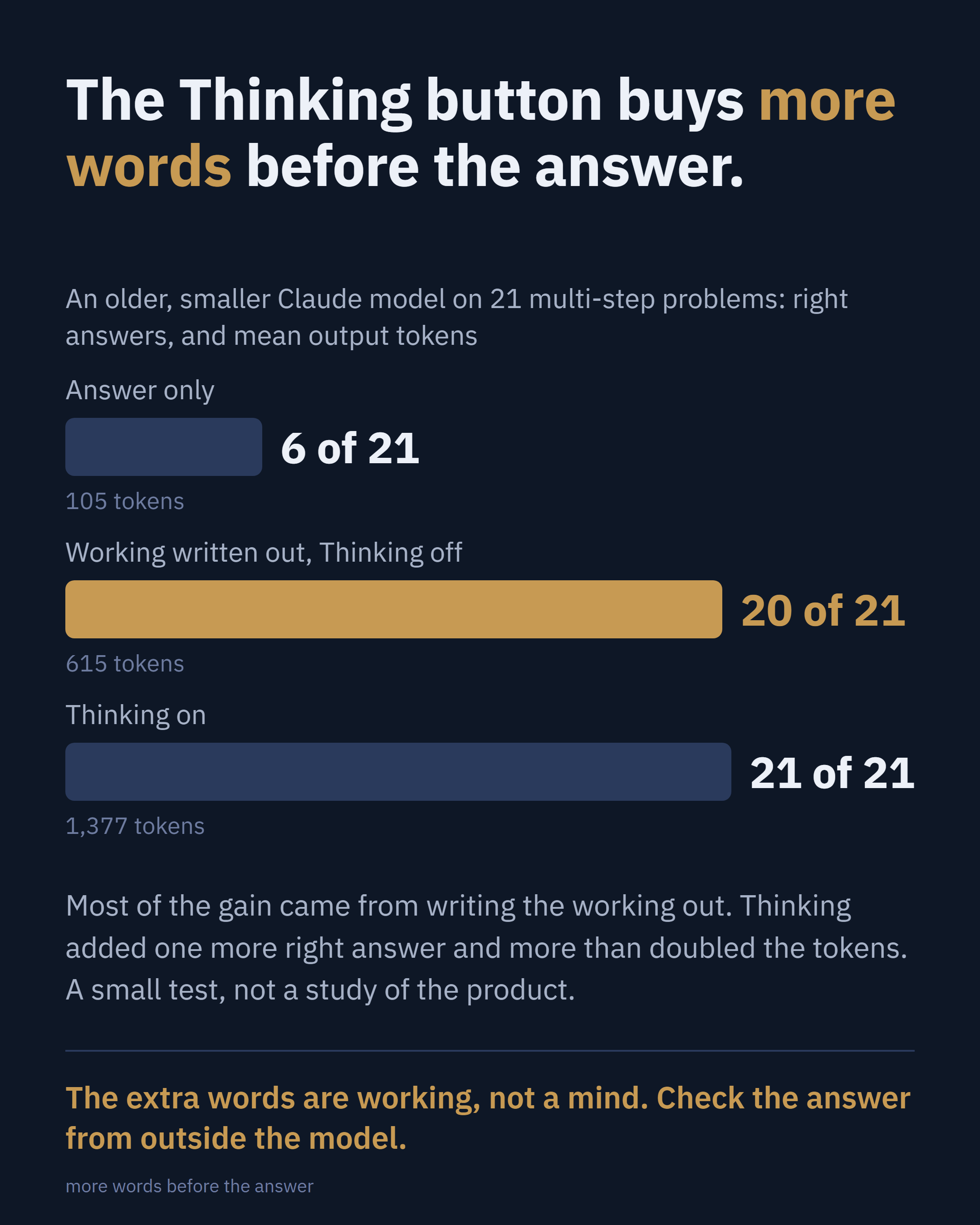
So we tested it. Same model, three ways to ask: just answer, write your working out in the reply with Thinking OFF, or Thinking ON. 86 problems, two Claude models (not the newest). Writing the working out is what helped. On multi-step problems the smaller model went from 6 of 21 right answering cold, to 20 of 21 writing it out, to 21 of 21 with Thinking on. On a harder set the two ways of writing it out weren't distinguishable, and for the smaller model Thinking cost two to two and a half times the tokens. Small test, lots of perfect scores, and part of the hard-set gap was a token cap I set too low...so read it as "no difference we could see," not "no difference."
(Yes, I had Claude test Claude, and Anthropic's research is all over this. The paper says so.)
That's not me saying it isn't capable. It is. In 2025 experimental versions of these models wrote gold-medal proofs at the math olympiad, in plain language, no prover. But that's math...the one place an answer key can mark it right or wrong, which is exactly what the public recipe trains the thinking on. Being good at the thing you were graded on isn't proof of a mind. And the text it writes while "thinking"? In Anthropic's own test in 2025, when a planted hint changed Claude's answer, its reasoning admitted using the hint 25% of the time. A study this summer found many models got more accurate on puzzle tasks when fed filler tokens that mean NOTHING.
Which brings me to the bigger word. On September 29 an executive order told federal agencies to stop saying "Artificial Intelligence" and start saying "Super Intelligence." Read section 3: it means exactly what the old term meant. Same tech, new label.
(The slowdown call from the lab heads in September is a different argument, about what these systems can do and what they're hooked up to. That one deserves to be taken on its own terms. It doesn't rest on the models thinking either.)
So here's where I land. "Thinking" and "superintelligence" are claims about a faculty. What ships is a trained text generator. Capable, uneven, and its own account of how it got there isn't reliable. The burden's on the words, not on us to disprove them.
And the fix is the same as everything else in this series. Don't worship it, don't wave it off...check it, with something that isn't the model :)
Sources
- What is an LLM?, the primer this one builds on
- Never let your AI grade its own homework
- Anthropic: Thinking (Claude Platform documentation) platform.claude.com
- Reasoning models don't always say what they think (Chen et al., Anthropic, 2025) anthropic.com
- Not all LLM reasoning is visible in the chain-of-thought (2026) arxiv.org
- Google DeepMind: Gemini Deep Think reaches gold-medal standard at the IMO, 21 July 2025 deepmind.google
- White House fact sheet: the Super Intelligence executive order, 29 September 2026 whitehouse.gov
- Freshfields: what the order says, including Section 3 freshfields.com