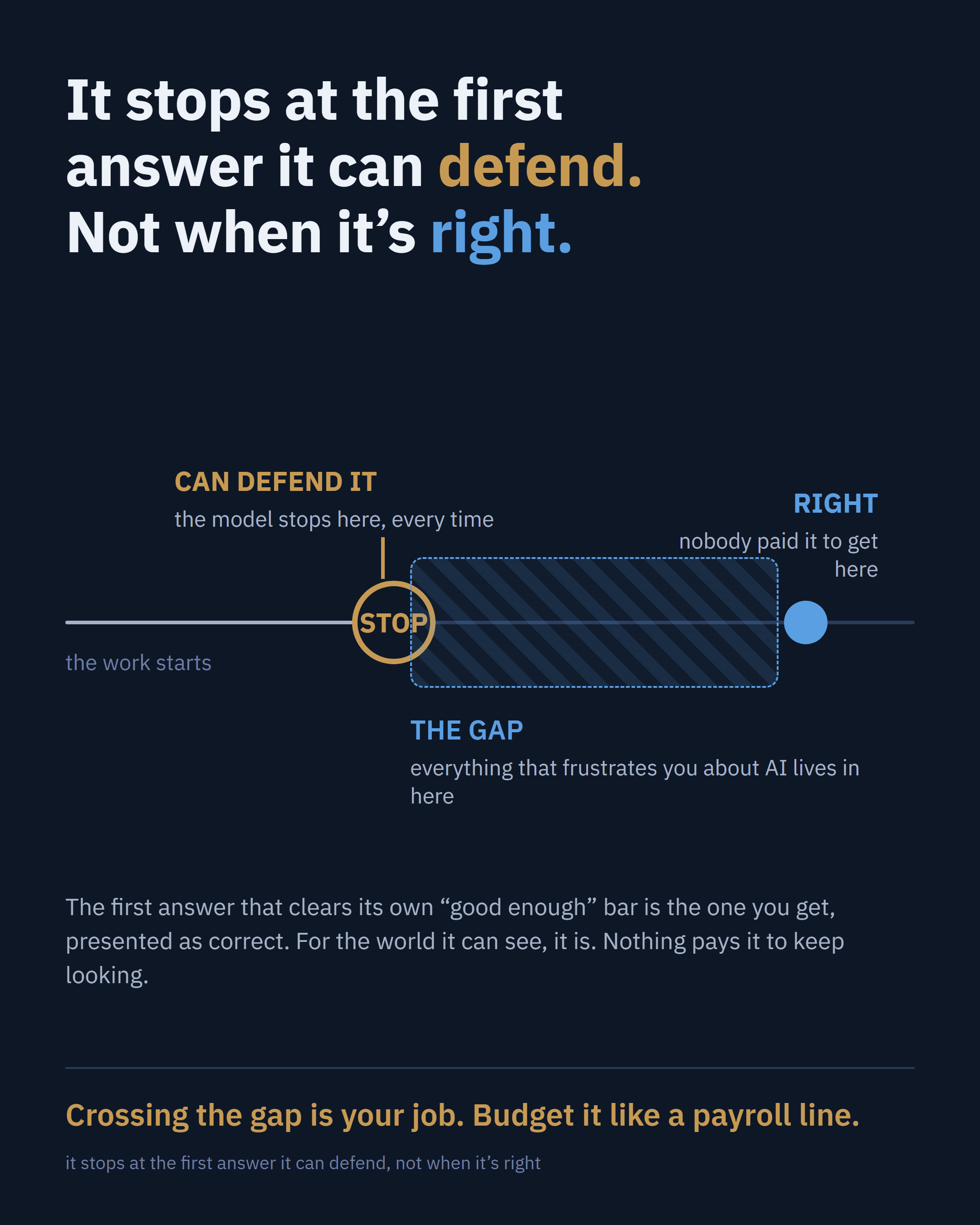
The model stops at the first answer it can confidently defend to you. Not when it's right.
The problem
This is the one that made everything else click for me, so it goes first. Once you see it, a lot of the "weird AI behavior" you deal with every day stops being weird.
Here's what's actually going on. The model looks at what's in front of it...your prompt, whatever files it happened to read, the conversation so far...and the first answer that holds up against THAT is the one you get. It hands it to you as correct, because for the little world it can see, it is. Nothing in how it was trained pays it to keep looking once it has an answer you'd accept, or to stop and ask "what am I not seeing?" So it IS lazy, in one very specific way: first good-enough answer wins. Every time.
You've already seen this, you just might not have connected the dots.
The confident answer that fell apart the second you checked it. Not a lie. The right answer to half the picture.
"Double-check your work" changing nothing. It re-reads the same evidence and defends the same answer. Mehta (2026) can actually detect the moment a model settles on an answer. What he can't detect is whether it settled on the RIGHT one.
Pushing back and watching it cave whether you were right or not. Kelley and Riedl (2026) tested nine frontier models: challenge one as a peer and it changes position either way. You didn't get accuracy. You got agreement.
And it's not just my experience. Ko and colleagues (2026) measured search agents that believed a task was finished while parts of it were still unchecked: 52% of answers for the strongest system they tested, 76% for a basic one. Even among the answers that were factually RIGHT, about 1 in 5 had never actually been checked.
Would you let a new hire close a case using only the files that happened to be on their desk? Of course not. You'd send them back for the rest. Nobody sends the machine back.
And this is a big part of why the makers can't answer "how do we use this?" for you. Where it stops, and whether that's good enough, depends on YOUR work.
What actually moves it from "defensible" to "right" is the next post.
Dealing with it
Your AI stopped at the first answer it could defend. Here's what actually gets it from there to "right"...and what doesn't, because some of the obvious stuff makes it worse.
Quick recap: it hands you the first answer that holds up against what it can see, and nothing in its training pays it to keep looking. You can't scold that out of it. But you can work with it, and this is what's worked for me running an AI team on real work every day, checked against the research.
Treat the first answer as a draft. A draft from a really bright junior who wants to be done. The cheapest change you can make to any AI workflow is deciding, ahead of time, that output gets reviewed before it gets consequences.
Don't ask it to check itself. Asked to self-correct with no outside input, models can take a right answer and make it wrong (Huang et al., 2023). Xu and colleagues (2026) found that bolting a self-review step onto a coding agent actually LOWERED its success rate. The check has to come from outside the thing that stopped.
Don't just push harder. A bare "are you sure?" flipped answers 46% of the time across ten models and cost about 17% of accuracy (Laban et al., 2023). Pressure doesn't change what it can see, so it just changes its mind, in whatever direction. Widen what it can see instead: the failing test, the doc it skipped, the number that doesn't add up. New evidence, not louder doubt.
Make it look before it commits. That same Xu study refused to let the agent make its change until it had actually looked at the evidence the task needed, and success went UP 4.8 to 11.8 points while using fewer tokens.
Don't hire a second AI as the judge. He and colleagues (2026) ran three models from three vendors with a fourth as the tiebreaker, and the tiebreaker made things worse. A simple non-AI classifier did better. Settle it with something that isn't a model: the source, the test, the record, you.
None of this needs a platform or a budget. It needs one decision the early stop can't survive: somebody, or something, sends it back :)
Sources
- Mehta (2026), When agents commit too soonarxiv.org
- Kelley and Riedl (2026), Personalization increases affective alignment but has role-dependent effects on epistemic independence in LLMsarxiv.org
- Ko et al. (2026), When is enough not enough? Illusory completion in search agentsarxiv.org
- Huang et al. (2023), Large language models cannot self-correct reasoning yetarxiv.org
- Laban et al. (2023), Are you sure? The FlipFlop experimentarxiv.org
- Xu et al. (2026), Preventing premature commitment in coding agentsarxiv.org
- He et al. (2026), Minority Sentinelarxiv.org