Your corrections are the most valuable data in your company.
The problem
They're free, they're already being written...and odds are you're deleting them.
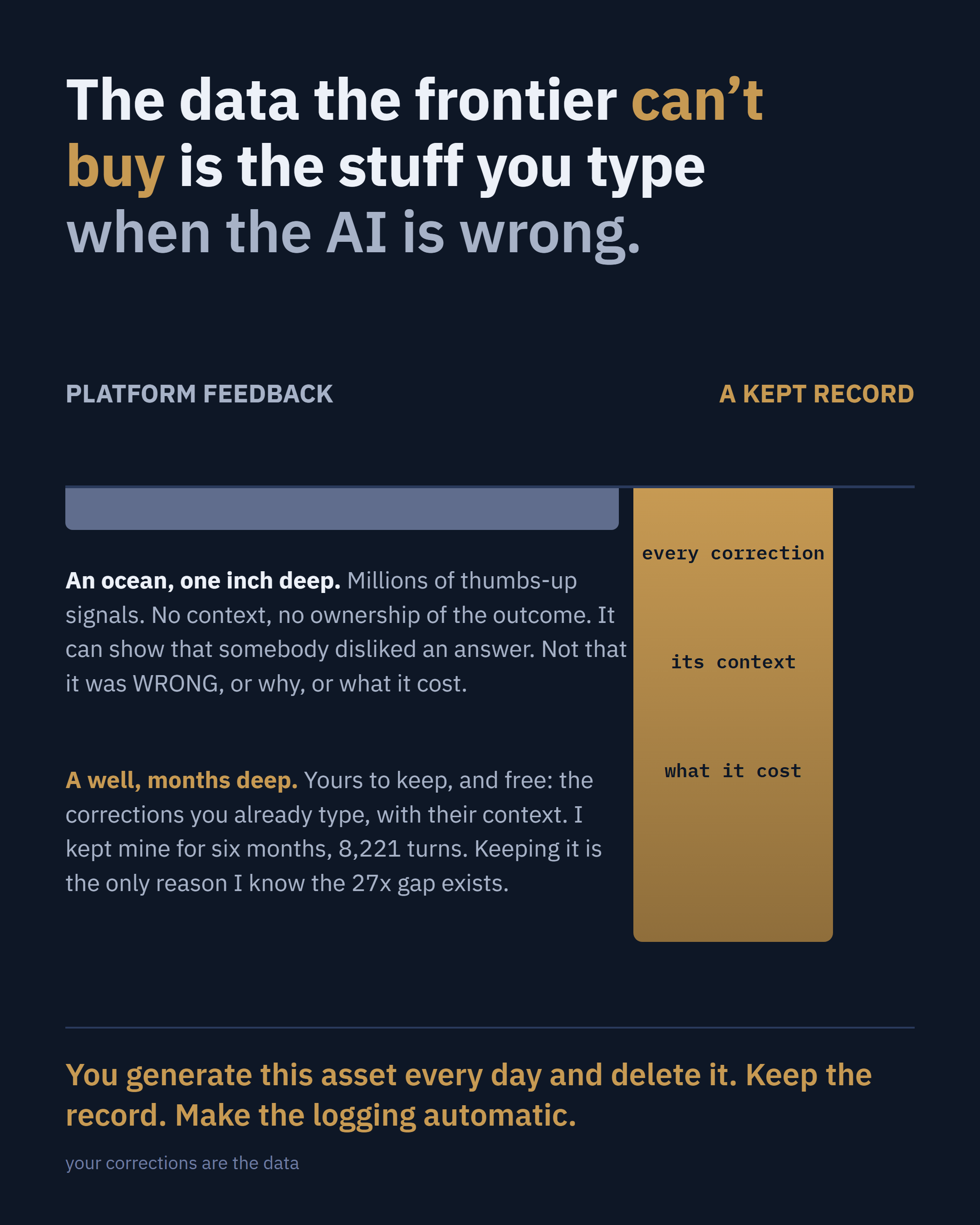
Every time you correct an AI, you're writing down a labeled example of your judgment on your work: what was wrong, why, and what right looked like. No lab can buy that. Think about what they DO get: thumbs-up buttons and preference clicks from millions of people who mostly don't own the outcome. That's the ocean one inch deep from my first post. A platform can see that somebody didn't like an answer. It can't see that the answer was WRONG, why, what the model had read, or what it cost you afterward.
You can see all of that. Your corrections carry it.
Here's what keeping them has shown me. I kept my record: six months, 8,221 of my own turns, every correction with its context. And keeping it is the only reason I know the big one: about 48% of what I typed was me correcting, redirecting, or teaching the AI (roughly a third once you price in the detector's error). The system's own logs caught 1.76%. If I hadn't kept the record, that 1.76% would've been the whole story, and I'd have believed it.
Every team that clears its chat history is living inside its own version of that gap, permanently, with no way to find out.
And it compounds. The model gets smarter every quarter with zero help from you. But your understanding of how to lead it...what it misses in your business, where you had to step in...that only builds up if the evidence survives the session.
Six months from now, the smartest thing in your AI setup won't be the model. It'll be your record of correcting it. If it exists.
Keeping it takes four habits and no budget. Next post.
Dealing with it
Keeping your AI record takes four habits and no budget. Here they are.
Recap: what you type when the AI is wrong is data you can't get anywhere else, and most teams delete it every day. So:
1. Stop deleting the transcripts. They're already being written. The delete is the only step you're adding. Storage is basically free, and the transcript is the raw record of what the model was told, what it produced, and what you had to fix. That's the asset. Just keep it.
2. Make the logging automatic. Anything that depends on someone remembering to write it down ends up near my 1.76%. If your tools have export options, history settings, or hooks, point them at a folder and forget about it. The bar: the record gets written even when everybody's slammed, because the machinery writes it, not anybody's discipline.
3. Graduate the corrections that matter...and keep the receipt attached. A fix that lives in chat scrollback is a fix you'll type twice. When a correction matters, promote it into the standing instructions the AI starts with, or into a check that refuses that mistake automatically. And keep the link back to the mistake that taught it. I learned that the hard way: I promoted eight lessons into my AI's standing memory, and the promotion dropped the link to the mistake each came from. So today I can't measure whether any of the eight changed anything. Zero of eight. Keep the link.
4. Once a month, read your own corrections back. Half an hour. You'll see the same handful of fixes on repeat, which tells you exactly what belongs in the standing instructions. You'll also see how you actually lead this thing, from data nobody else has.
One honest caveat: my record is one person's, and I treat it that way. It's also private, client work and my own, and yours should stay yours too. That's the point. It's YOUR data. The labs can't buy it, and you're the only one who can throw it away.
Sources
The numbers in this post come from my own record. How each one was measured, with its window, is in the background paper.