Three Valleys, Not One
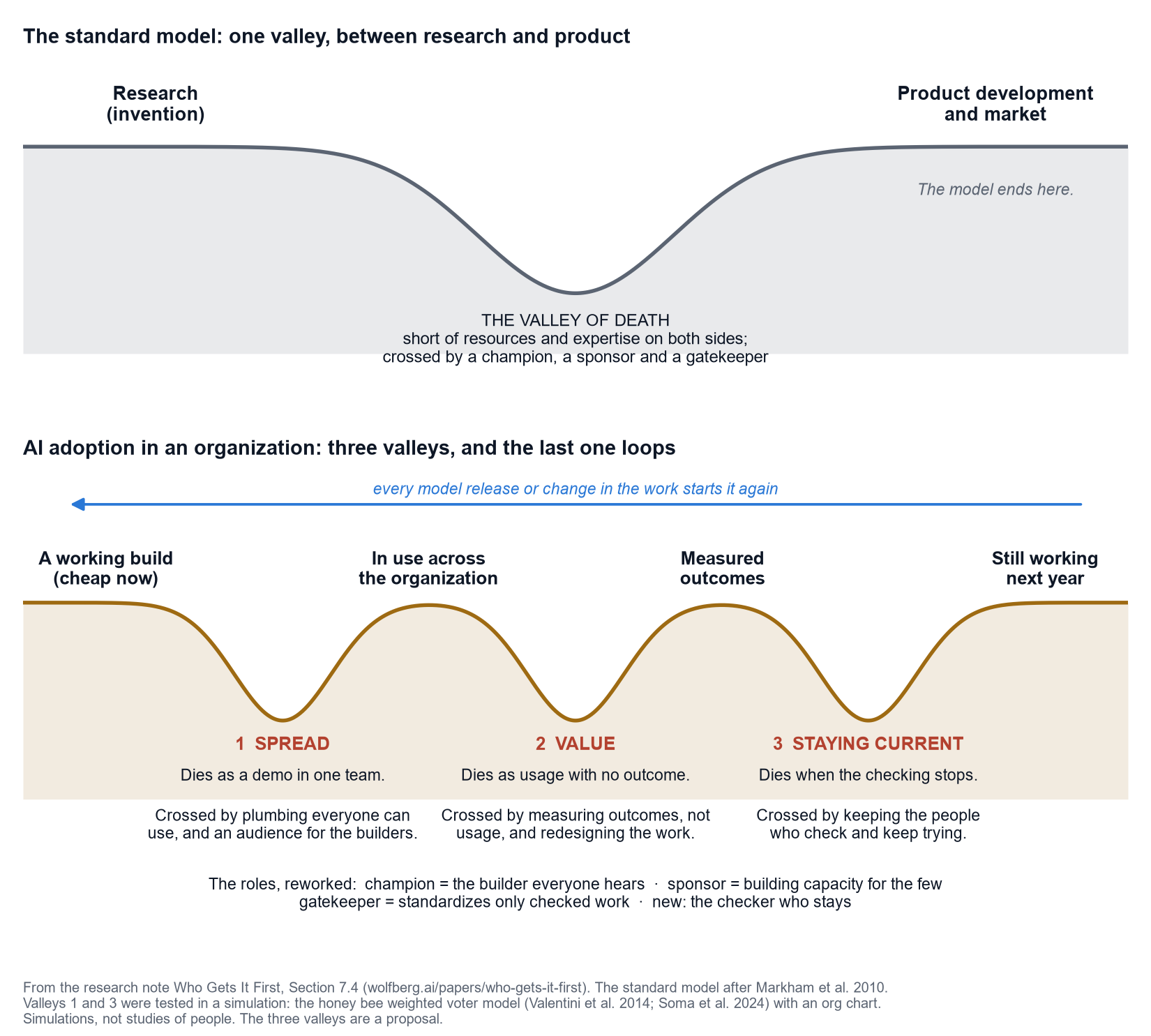
The standard picture of adopting a new technology has one valley of death. For AI inside an organization I count three, and the last one starts over every time the model changes.
The standard valley sits between research and a product, where a project runs short of resources and expertise, and it gets carried across by a champion, a sponsor and a gatekeeper. With AI a working build isn't the hard part anymore, and the things that kill an effort come after it.
The first valley is spread, where a good build stays a demo in one team, and this is also where the money stops. In my experience the R&D gets funded, and most of the time nobody gets funded to take the result to the rest of the organization and get it traction, so the rug gets pulled on a lot of efforts right at the start of the valley. Government auditors found the same thing in 2006 comparing the Defense Department with four leading companies: in the companies the lab that builds a technology also pays to hand it over, and in the department the receiver pays, so the developer has nothing at stake.
The second valley is value, where everyone uses it and nothing measurable changes. The UK's Department for Business and Trade found people liked its Copilot pilot and reported saving time, and found no robust evidence the time saved improved productivity (measuring that was not a key aim of the evaluation), which is why I don't treat seats or usage as the measure.
The third valley is staying current: it works, everyone stops checking, and when the model or the work changes the organization can't follow. A software project ends at go-live, which is right where this valley starts, and the vendor sets the outer clock: the eleven models Anthropic has retired or scheduled lasted a median of 14 months, on about two months of notice, and switching by choice only adds to it.
I tested the first and third in a simulation, the honey bee voting model from my research notes (Valentini et al. 2014, Soma et al. 2024) with an org chart added. With nobody paying to carry ten strong builders' work the organization gained 0.28, where 0.5 is the most it could. When the builders paid, presenting half the time instead of building, it dropped to 0.23, and five people assigned to carry the work got 0.44. Then I changed the best way of working six times. Every plan where nobody tries anything new after the rollout followed 0 of 23,752 needed moves, checks on or off. Ten people who kept checking and trying things followed 54 to 82 percent, depending on how far apart the changes came, and 87 to 99 percent when everyone could hear them. It has nothing to say about the second valley.
So the roles change. The champion is the builder everyone can hear, the sponsor pays for the carry and not out of the builders' time, the gatekeeper standardizes only work that has been checked, and two roles are new, the carrier and the checker who stays.
The three valleys are my proposal, not a finding, and the simulations are simulations, not a study of people. The paper has the figures and the sources.
Sources
- Best practices: Stronger practices needed to improve DOD technology transition processes (U.S. Government Accountability Office, GAO-06-883, 2006) gao.gov
- The valley of death as context for role theory in product innovation (Markham, Ward, Aiman-Smith and Kingon, 2010) doi.org
- Microsoft 365 Copilot pilot: DBT evaluation report (UK Department for Business and Trade, 2025) gov.uk
- Model deprecations (Anthropic, read 3 October 2026) platform.claude.com
- Who Gets It First, the research note whose Section 7.4 first set out the three valleys
- The hive mind is a single reinforcement learning agent (Soma, Bouteiller, Hamann and Beltrame, 2024) arxiv.org