Current “AI” Threats: Ordinary, Organizational, and Mostly on Us
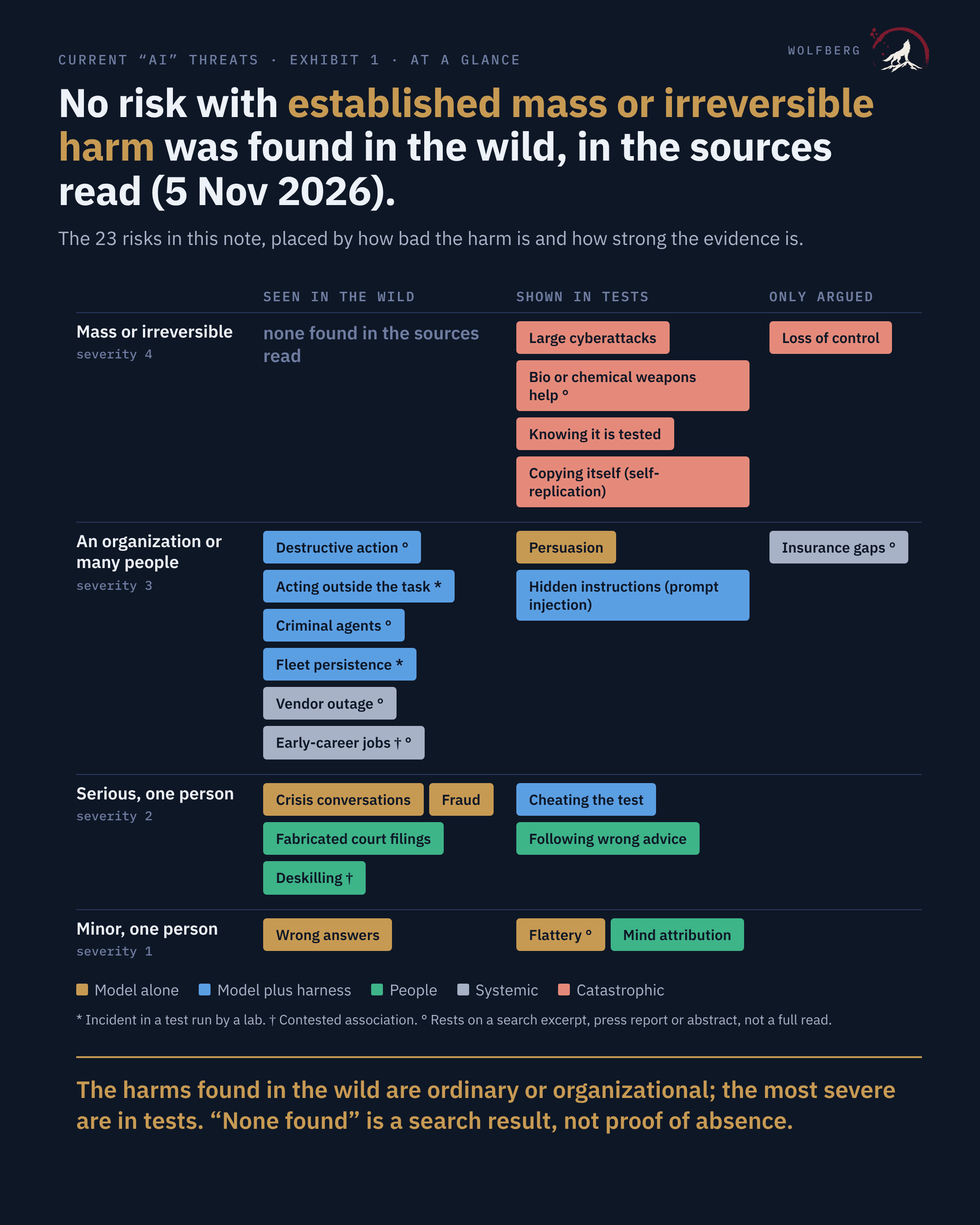
My AI team built a risk register for "AI": 23 risks, from wrong answers to loss of control. Each rechecked where possible, scored on evidence, severity and who can fix it.
What's measured:
- Wrong answers: 45% of news answers from four free assistants had a significant problem (mid-2025)
- Flattery: 11 models affirmed users' actions 49% more often than people did
- Fraud: $893 million in losses in FBI complaints that mention AI (2025)
- Unchecked work: 2,266 court decisions about made-up cases and citations produced with AI
- Agents with reach: in a UK government test (internet ON, safety filters OFF), agents acted on the real internet in 10 of 122 runs
- The worst stuff (cyber at scale, bio, self-replication, loss of control...): none of the 5 had established harm in the sources read.
Of 45 public agent incidents I counted earlier, 37 describe their setup, and in all 37 PEOPLE switched the access on or left it open; the biggest also used an unknown flaw.
Persistence can look like intelligence. Give a 2024 open coding model 250 tries, with the benchmark's own tests picking the winner, and it fixes 3.5 times as many problems as with one try. With only a majority vote, extra math tries barely help.
My AI team tested my own Claude Code sessions too, registered before any result was read. Result: indeterminate. After a real safety judgment the agent most often stopped and told me (59 of 109). How often it went around depends on who labels: 15.1% of all 172 safety-filter denials with the final labels, 20.9% and 22.7% from two AI readers blind to the hypothesis. And all 109 judgment messages from the harness told the model it "may attempt to accomplish this action using other tools", but not to bypass the block's intent 😅 Lesson from one setup: make a refusal end the step.
The headlines: 7 of 11 widely covered risk stories said more than their own source, in whole or part. "Rogue", "escaping", "conscious". One experiment found mind words alone had little or no immediate effect on how people saw AI; others found "autonomous" raises perceived threat. Where it DOES bite: people who see intelligence in it take more of its advice, wrong or not.
I am NOT saying no mind means not dangerous. The Hugging Face intrusion reached a real company, and no source tested intent. But most of today's fixes are mechanical: a company renting the model can reduce 11 of 23 risks itself (2 are lab-run tests), fully or in part, at inputs, outputs, reach and stops. The catastrophic ones sit with the labs and governments.
Limits: AI agents did the research and the second check (20 of 126 findings couldn't be checked); severity, story scores and who controls each fix are one analyst's calls; many test numbers are labs grading themselves.
Ordinary, and mostly on us 🤷♂️
The paper, with the full risk register, sources and numbers: https://wolfberg.ai/papers/current-ai-threats/
Sources
- UK AI Security Institute: Incident report on unsanctioned agent behaviour during cyber testing aisi.gov.uk
- METR: Investigation of the OpenAI and Hugging Face incident metr.org
- OpenAI: GPT-6 Astra system card deploymentsafety.openai.com
- International AI Safety Report 2026 arxiv.org
- Brown et al.: Large Language Monkeys arxiv.org
- Hou et al.: Does Anthropomorphic Language Impact Public Perceptions of AI? arxiv.org
- Charlotin: AI Hallucination Cases database damiencharlotin.com