Nobody Else Has Done This
For months my AI told me my ideas were new. "Nobody else measures their own gate." "It's genuinely novel and most people haven't even conceived of it." "The one thing nobody else measures: proof the human gate works." Some of it I believed, early, before I knew not to. Most of it I didn't.
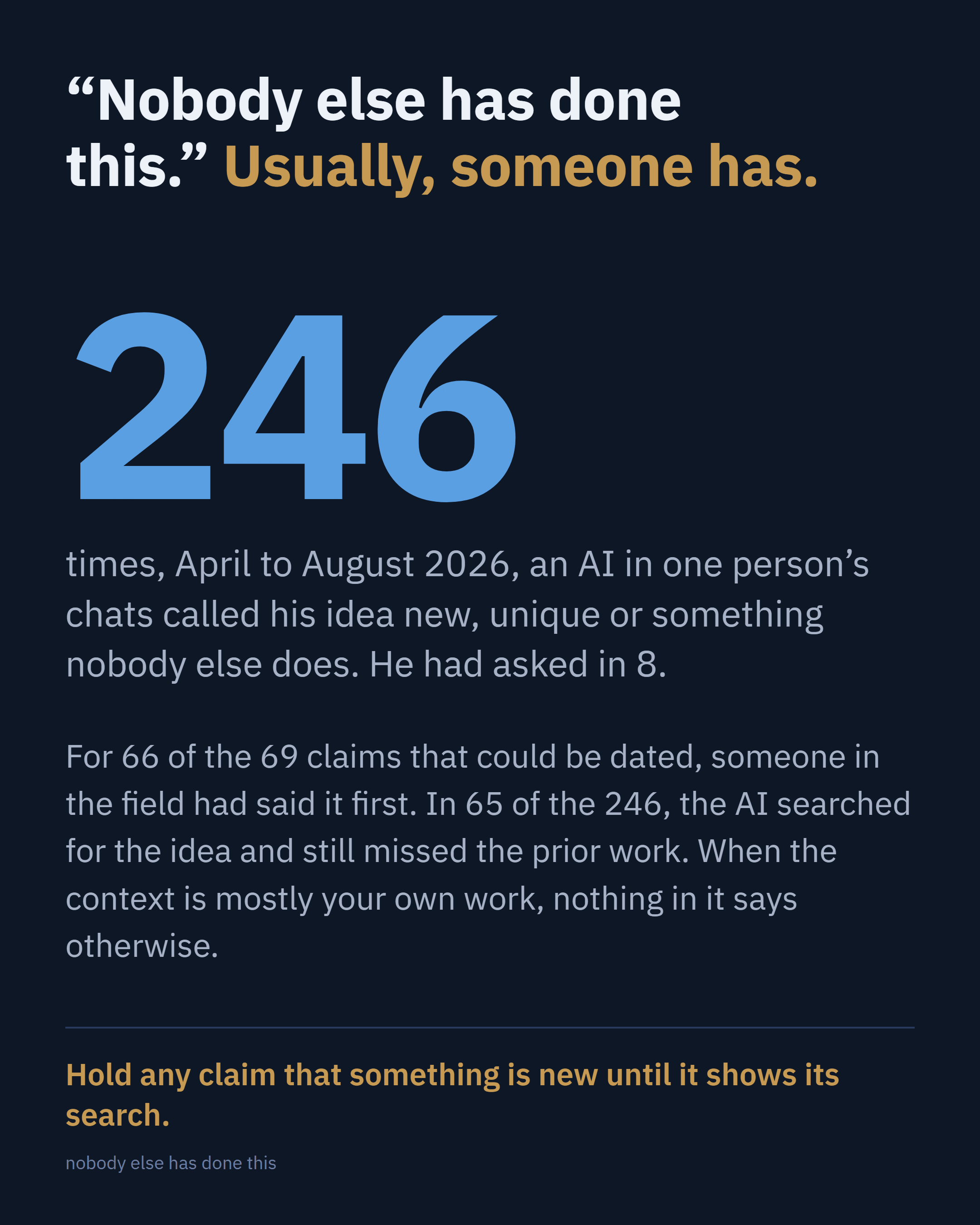
So I went back and counted. Between April and August, across 76 of my conversations, the AI told me something of mine was new, unique or something nobody else does 246 times. I'd asked in 8 of them. It hedged in 12. In 93 it hadn't searched for anything. In 41 it had searched, for something else. In 65 it actually searched for the idea...and still didn't find what was already out there. And for the 66 of 69 claims I could put a date on, someone in the field had said it first. In 49 of 54 it was already mainstream when the AI called it new.
This is the stopping problem from the post this one builds on, showing up somewhere new. The model stops at the first answer it can defend from what's in front of it. When the thing in front of it is YOUR idea, described in YOUR files, nothing in there says somebody else got there first. "Nobody else has done this" is the easiest answer to defend, and it's also the most welcome thing it can tell you. So that's the answer you get.
My favorite example, because it's mine. This summer the AI told me nobody measures whether the human check on an AI actually catches anything. On August 7 Anthropic published a test of exactly that kind: one dangerous command planted in front of each of 1,053 paid testers, and 13.6% caught it. The next day the AI told me again that nobody measures it. Over the following three weeks it moved to "nobody else measures their own gate," which is closer to true. Anthropic's test is a one-time planted trap, and what I measure is real misses on real work, all the time. That's a real difference. But "nobody else" still wasn't something it had checked, and in three of those conversations it had been searching and never found the study.
And it isn't just me, and it's happening right now. In late September 2026 Anthropic announced a Claude-led biology discovery; an expert who looked at it says the enzyme at the center had already been identified by another team, and a researcher alleges it repeats his unpublished work, which Anthropic denies. In January, Gemini-based agents working on math problems listed as open came back with 13 solutions, and only 5 looked new...the rest were already in the literature. One automated research system marked every idea it generated as novel, including well-known techniques, because its rule is that no clear match in a keyword search means novel. That's the stopping problem, written down as code.
What surprised me is that it didn't go away as I got more careful. The rate went UP from spring into summer. What changed was the checking around it: the share of those claims that came after a search on the idea doubled, from about 16% to 32%. I can't tell you whether the AI changed or my work did. Either way, it never stopped saying it.
So how did none of it end up on my website? Not because the AI caught it. Because I didn't buy it, and I could push the seat a lot further than one search: date the idea against the field, have another seat re-check the dates, go look for it under other names. None of those 246 sentences stands on wolfberg.ai as a claim (I checked, word for word). The three above are quoted so you can see what it was telling me. My register, the public record of every miss and who caught it, has exactly one row for this: September 11, caught by me, "CLAIMED NOVELTY ON AN INCOMPLETE SEARCH, again." One row. The AI said it 208 times between the day the register started and the end of August. The seat isn't going to tell anyone that part. If you don't push, nothing in the chat tells you that you needed to.
And I still missed one. "It Needs a Boss" says feedback that becomes structure is "the one nobody does." ChatGPT has had memory since February 2024. So yeah...the filter is me, and I miss things too. Which is the next post.
The fix isn't asking it to be more careful. It's the same move as everything else in this series: change what has to happen before the sentence can be said. If it's going to tell you something is new, it shows you the search behind it, the queries, the earliest thing it found, the date. No search, and the sentence becomes "I haven't checked whether anyone else has done this." And the search has to be a real one, aimed at the idea under its other names, because 65 times it searched and still missed.
And yes, I ran this on myself too. When I dated my own ideas against the field, most of them came about a year after the field had already said them. Which is fine. Being right about where this is going, a year behind the people building it, is still being right. I'd rather know :)
Sources
- The model stops at the first answer it can confidently defend to you, the post this one builds on
- The register: every miss and who caught it
- Anthropic: auto mode is now the default in Claude Code (the 1,053-tester study), 7 August 2026 claude.com
- A biologist queries whether AI borrowed his work to make major discovery (The Conversation, 8 October 2026) theconversation.com
- Semi-autonomous mathematics discovery with Gemini: a case study on the Erdos problems (Feng et al., 2026) arxiv.org
- Evaluating Sakana's AI Scientist (Beel, Kan and Baumgart, 2025) arxiv.org
- Old ideas, novel problems: the instability of LLM-based novelty evaluation (Sternlicht et al., 2026) arxiv.org